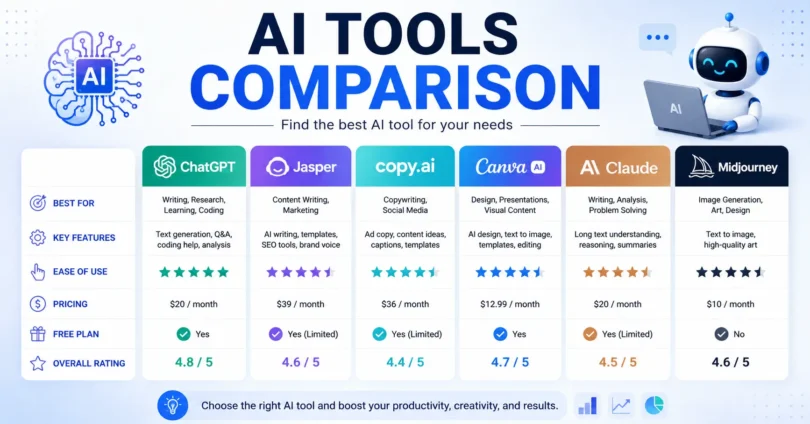
AI tools are becoming a part of everyday work, study, and business. People use them to write content, create images, edit videos, write code, and complete many other tasks faster. However, not every AI tool offers the same features, price, or performance. AI tools comparison, Is important before choosing one. By comparing different AI tools, you can understand what each tool does best, how much it costs, and which one matches your needs. AI tools in a simple way, making it easier to choose the best option for your goals, budget, and daily work.
Why Comparing AI Tools Matters Before You Choose One
Comparing AI tools before choosing one helps you make a smarter decision. Every AI tool is built for different tasks, so the best choice depends on what you need. Some tools are better for writing, while others work well for image creation, coding, video editing, or data analysis. By comparing their features, pricing, ease of use, accuracy, and customer support, you can find the tool that gives the best value for your money. A good comparison also helps you avoid paying for features you may never use. Whether you are a student, freelancer, business owner, or content creator, taking a few minutes to compare AI tools can save time, reduce costs, and improve your results in the long run.
How to Compare AI Tools the Right Way
Choosing the right AI tool becomes much easier when you compare the most important factors before making a decision.
- Check the Main Features: Compare what each AI tool can do and make sure it offers the features you need.
- Look at Ease of Use: Pick a tool with a simple and user-friendly interface so you can start using it quickly.
- Compare Output Quality: Test how accurate, useful, and reliable the results are for your tasks.
- Measure Speed: A good AI tool should generate results quickly without reducing quality.
- Review Pricing Plans: Compare free and paid plans to see which tool gives the best value for your budget.
- Test Free Versions: Use the free trial or free plan before buying to understand how the tool works.
- Check Integrations: Make sure the AI tool works with the apps and platforms you already use.
- Read User Reviews: Look at feedback from real users to learn about their experience and common issues.
- Compare Security and Privacy: Choose a tool that protects your personal and business data.
- Evaluate Customer Support: Good customer support can save time if you face any problems while using the tool.
Comparing AI tools step by step helps you choose the best option based on your needs, budget, and long-term goals.
Types of AI Tools You Can Compare
AI tools are made for different tasks, so compare the type that matches your needs.
- Writing AI Tools
- Image AI Tools
- Video AI Tools
- Coding AI Tools
- Research AI Tools
- Productivity AI Tools
Compare the right type of AI tool to find the best one for your work.
Feature by Feature AI Tools Comparison
Comparing AI tools feature by feature helps you understand their strengths, making it easier to choose the best solution for your specific needs.
| Feature | What to Compare | Why It Matters |
| Ease of Use | Interface | Simple for beginners |
| AI Accuracy | Output quality | Better results |
| Speed & Performance | Response time | Saves time |
| Content Types Supported | Text, images, code | More flexibility |
| Customization | Settings & style | Personalized output |
| Integrations | App compatibility | Better workflow |
| Security & Privacy | Data protection | Keeps data safe |
| Pricing | Free vs. paid | Fits your budget |
| Customer Support | Help options | Quick assistance |
| Best For | User needs | Easier selection |
A detailed feature by feature comparison ensures you invest in an AI tool that offers the right balance of performance, usability, and value.
Which AI Tool Is Best for Different Users?
The best AI tool depends on your goals and the type of work you do.
- Students: AI tools for learning, research, and assignments.
- Bloggers: AI tools for writing and SEO content.
- Businesses: AI tools for marketing and customer support.
- Developers: AI tools for coding and debugging.
- Designers: AI tools for images and graphic design.
- Freelancers: AI tools for managing different client tasks.
Choose an AI tool that matches your daily work and specific needs.
Tips to Choose the Right AI Tool
Follow these simple tips to choose the best AI tool for your needs.
- Know Your Goal: Choose a tool that fits your work.
- Set Your Budget: Compare free and paid options.
- Check Features: Make sure it has the tools you need.
- Try the Free Version: Test the tool before buying.
- Read User Reviews: Learn from real user experiences.
- Choose an Easy Tool: Pick one with a simple interface.
The right AI tool should match your goals, budget, and daily tasks.
Common FAQs about AI Tools Comparison
Here are some Faqs of AI Tools Comparison:
Can I use multiple AI tools together?
Yes. Many people use different AI tools for different tasks, such as writing, image creation, and video editing, to get better results.
Do AI tools need an internet connection?
Most AI tools work online and require an internet connection, but some desktop AI software also offers limited offline features.
How often are AI tools updated?
Most popular AI tools receive regular updates to improve performance, add new features, and fix security issues.
Can AI tools work on mobile devices?
Yes. Many AI tools have mobile apps or responsive websites that allow you to use them on smartphones and tablets.
Are AI tools available in different languages?
Many AI tools support multiple languages, making them useful for users around the world.
Can AI tools be integrated with other software?
Yes. Many AI tools connect with apps like Google Workspace, Microsoft Office, Slack, Notion, and other business platforms.
Do AI tools require technical skills?
No. Most modern AI tools are designed for beginners and have simple interfaces that anyone can learn quickly.
How can I keep my data safe while using AI tools?
Use trusted AI platforms, enable two-factor authentication if available, avoid uploading sensitive information, and review the tool’s privacy policy before use.
Conclusion
Choosing the right AI tool becomes easier when you compare your options carefully. Every AI tool has different strengths, features, and pricing, so the best choice depends on your needs and goals. By understanding what each tool offers, you can save time, improve your work, and get better value for your money. Use this AI tools comparison as a guide to find the solution that helps you work smarter and achieve better results.